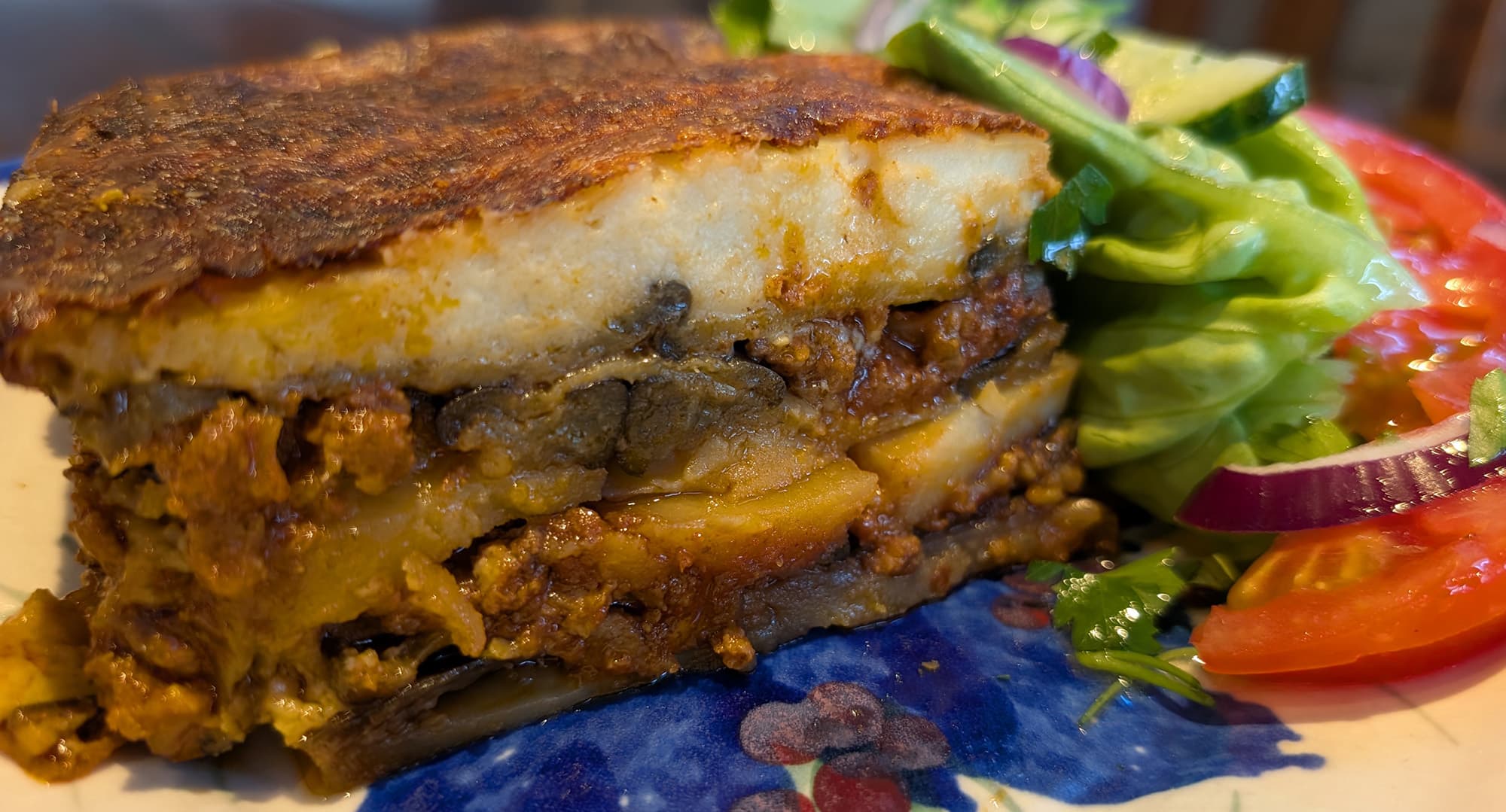
Why This Works Without Smell
When I asked my mum, who hasn't been able to smell for decades, what she wanted me to cook for her birthday, her answer was moussaka (or mousakas as it's known in its native Greece). This recipe is an adaptation of the one given me by an old colleague, Aliki, who is from Athens and who wrote down her mother's homemade version of the Greek classic for me.
There’s something almost addictive about the savoury, umami hit of well-cooked aubergines, balanced by the sweetness and slight acidity of the tomato and finished with the salty richness of the parmesan-topped béchamel.
Texture matters too: the smooth béchamel, the chew of the beef, and the slight bite of the potatoes, all finished with a thin, crisp parmesan crust.
The key is the aubergines: use riper, softer, larger ones if you can, as they are far tastier.And if you can leave the fried slices overnight before assembling, it really deepens the flavour.
Mousakas is tradtionally made with beef, not lamb, is best eaten warm, rather than hot, and is even better the next day.
Ingredients
- Olive oil for frying (quite a lot)
- 4 large, ripe aubergines, cut into 0.5cm slices, sprinkled with salt and patted dry
- 1kg potatoes, peeled, cut into 0.5cm slices
- 500g minced beef
- 3 onions
- 3 cloves garlic (I like it garlicky) crushed
- 500ml passata
- 1 cinammon stick
- 1 bay leaf
- Salt, pepper
- 100g salted butter
- 100g plain flour
- ~2 pints milk, warmed
- 0.5tsp ground nutmeg
- 2 eggs, lightly beaten
- 100g Parmesan
- A few knobs of butter
Method
1. Fry the aubergines and potatoes
Fry the aubergine until slightly browned, set aside in a colander.
Fry the potatoes until slightly browned, set aside in another colander.
Leave them as long as possible; at least a few hours, preferably overnight.
2. Make the beef and tomato sauce
Fry the onions, stirring on a high heat, until translucent and starting to brown, about 10 minutes.
Add the mince, give it one stir and leave, still on a high heat, until the mince is nearly cooked through.
Add the garlic, stir again and leave again, until the meat is starting to stick slightly to the bottom of the pan. You want those brown sticky bits (the fonds) to help deepen the sweet savouriness of the sauce.
Add the passata, scraping the bottom of the pan until the fonds has dissolved. Add some water from the kettle if necessary. Season, add the cinnamon and bay leaf and cook on a low heat for an hour.
After cooking, leave as long as possible before assembling the dish, to let the flavours develop.
3. Make the béchamel
Melt the butter over a low heat, add the flour, stirring until it becomes a paste, then slowly, splash by splash, add the milk and incorporate into the paste. You want it to be quite thin, say, the texture of double cream.
Season and add the nutmeg. Remove from the heat and leave to cool for a few minutes, then stir in the eggs until they are fully incorporated.
4. Assemble and bake
Pre-heat the oven to roughly 180C, gas mark 7.
In a large oven dish, first put a layer of potatoes, then a layer of aubergines, then the meat sauce, seasoning all the way. Finish with any leftover aubergines, then pour over the becahmel. Grate over the parmesan and dot with the butter.
Bake for an hour, until the topping is a deep brown, then remove and leave to cool before serving.
This is a rich dish, so I like to serve it with a sharp green salad, sprinkled with lemon juice.
Tips
Timing: Yes, done properly, this dish takes a long time, with large amounts of waiting, but it definitley rewards your patience.
The meat sauce: Cooking meat on a high heat starts the maillard reaction, which is what creates the fonds that elevate the sauce from average to great. It is this reaction that people with anosmia can still taste, so it is important to ensure it happens. As a result, I'd always advise you to hold your nerve when you are browning mince, as a lot of people have a tendency to try and stir-fry it, which can prevent the maillard reaction from starting and in the worst case scenario can lead to the mince boiling in its own water and becoming tasteless.
On aubergines: I have a greenhouse for one reason and one reason only: growing my own aubergines. It's a lot of effort, but if you can't taste, a well-cooked aubergine can give you a real umami kick. I use my home grown aubergines to make this recipe, parmigiana and ratatouille, all of which are great for people with a limited sense of smell.